The Wisdom of Holding Ground
An anchor is a promise made to the bottom.
It is easy to think of an anchor as a weight. Something heavy. Something thrown overboard to stop movement. That is only the plainest version of the truth.
I have learned, though, that an anchor does not hold because it is heavy. It holds because it is set.
The distinction matters.
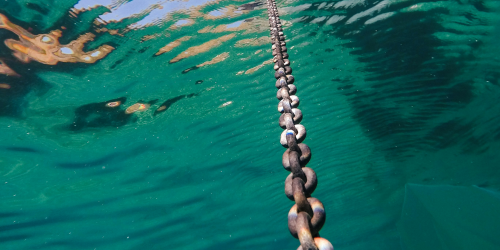
A sailor can drop the anchor in a hurry, hear the chain run, feel the boat slow, and believe the work is finished. It is not finished. Not yet. The anchor must find the bottom. It must bite. It must be given enough scope. It must be tested against the pull of wind and tide. Only then can a man begin to trust that the vessel will remain where he has placed her.
Anyone who has spent time at anchor knows the small discipline that follows. You do not simply drop the hook and forget the sea exists. You look around. You take a bearing on the shore. You notice the distance from another vessel, the shape of the cove, the direction of the breeze, the room you have to swing. You feel the boat come back against the rode. You wait for the pull to settle into something that feels less like drifting and more like hold.
Even then, the boat moves.
She turns with the wind. She rises and falls. She swings through her arc as the tide changes. A person unfamiliar with anchoring might mistake that motion for uncertainty, but it is not uncertainty. It is the natural movement of a vessel that has found a fixed point beneath the surface.
That is the lesson.
A man may adjust without drifting. He may respond without surrendering. He may move with the conditions around him and still remain fast to what matters.
The water teaches this with very little sentiment. Poor holding ground reveals itself. The breeze freshens. The tide turns. The boat begins to drag. At first, the movement may be subtle. A landmark shifts. A bearing changes. The distance to shore closes in a way that should make the careful man uneasy.
Then comes the truth.
The anchor was down, but it was not holding.
Life works much the same way.
Many men believe they have principles because they have opinions. They believe they have convictions because they speak with confidence. They believe they have chosen their ground because they can describe it well. Then pressure comes, and the truth appears.
A principle that cannot endure inconvenience is not yet a principle. A conviction that changes with applause is not yet conviction. A standard that bends every time belonging is at risk is not a standard. It is decoration.
Holding ground begins before the weather turns.
That is why the previous lesson matters. You take soundings first. You measure the depth. You learn what is beneath the surface. You do not commit your weight to shallow water and then congratulate yourself for courage. You find what can hold. You choose carefully. Then, once the anchor is set, you give your decision the dignity of endurance.
This is where many people lose themselves. They do the work of discernment, then abandon the result the moment resistance appears. They ask the questions. They see the truth. They know what they should do. Then a little discomfort arrives, and they begin looking for an excuse to drift.
Drift often arrives well dressed.
It calls itself flexibility. It calls itself open-mindedness. It calls itself keeping options available. At times, those are virtues. An experienced man should be capable of adjustment. He should not confuse rigidity with strength.
Still, constant repositioning eventually becomes a confession.
You cannot build a serious life if you move every time the wind changes. You cannot become trustworthy if your loyalties are always under review. You cannot lead if your standards depend on the company in the room. You cannot carry a name, a family, a calling, or a meaningful ambition if you have no fixed relation to the bottom.
Some things must be held.
Not loudly. Not theatrically. Not with the cheap defiance of a man who mistakes stubbornness for courage. Stubbornness clings to a position because the ego has become involved. Conviction holds because truth has been measured, chosen, and accepted.
There is a great difference between being unable to move and being unwilling to drift. The first is weakness. The second is strength.
A man’s ground is tested most clearly by the things that try to move him quietly. Not always catastrophe. Not always betrayal. Not always the great dramatic storm that arrives with black clouds and obvious warning.
Sometimes the test is flattery.
An invitation comes with just enough prestige to make compromise look harmless. A room opens, but the price of entering is a small surrender of judgment. A partnership appears promising, provided a man pretends not to notice what he has already seen. He tells himself that he can step a little away from his own standards and return to them later.
That is how anchors drag.
Rarely all at once. Rarely with a great sound. More often, the movement is gradual enough to be excused until the vessel is no longer where she was meant to be.
Sometimes the test is criticism.
A man takes his position carefully. He measures. He decides. He begins to build. Then the voices come. Some misunderstand him. Some resent him. Some question the very thing he knows he has been called to carry. If he has not set his anchor deeply, he will start trimming his life to satisfy people who were never responsible for his voyage.
That is a poor exchange.
A man who wishes to be respected must first become capable of being misunderstood without immediately changing course. Not every objection deserves obedience. Not every opinion carries authority. Not every gust should determine the position of the vessel.
There are times to listen. There are times to amend. There are times to admit that the holding ground was poor and move before damage is done.
There are also times to remain.
Holding ground does not mean refusing correction. It means knowing the difference between correction and pressure. It means recognizing when a thing has been tested enough to deserve loyalty. It means allowing a worthy commitment to mature past the first discomfort.
This applies to work. It applies to friendship. It applies to family. It also applies to reputation, discipline, and the private architecture of a man’s life.
Every serious pursuit will eventually ask whether you meant what you said.
The early days of anything can be intoxicating. I recognize that in myself. A new project carries the shine of possibility. A new discipline offers the satisfaction of beginning. A new friendship or alliance can feel clean and full of promise. A man sees the shape of something ahead and feels the old pull toward movement.
Then the first weather arrives.
The work becomes repetitive. The applause fades. The results come slower than expected. The person disappoints you in some ordinary human way. The road that looked noble from a distance becomes plain, demanding, and without much romance.
That is when holding ground begins.
Not at the beginning, when everything feels chosen. Later, when the choice has to be chosen again.
A man’s life is shaped less by the vows he makes in bright weather than by the ones he keeps when the tide turns.
This is why an anchor must be set properly. You cannot wait until the squall arrives to decide what sort of man you intend to be. You cannot build standards during the hour when they are being tested. You cannot discover loyalty only after loyalty becomes costly.
The groundwork has to be done in calmer water.
You decide in advance what you will not sell. You decide what kind of rooms you will enter and what kind you will leave. You decide what your name is allowed to stand beside. You decide what your work must be worthy of. You decide which people deserve the full weight of your presence and which deserve courtesy from a distance.
Then you live accordingly.
This sounds simple. It is not easy.
A life without hold can look free from a distance. No fixed point. No lasting obligation. No standard strong enough to limit the next choice. It may appear light, adaptable, and unburdened.
The sea gives a clearer lesson.
A vessel without hold is not free. She is at the mercy of whatever moves her.
Freedom requires more than motion. It requires command. Command requires a relation to something firmer than the surface.
That is what holding ground gives.
It does not remove the wind. It does not flatten the sea. It does not silence every voice from shore. It gives you a fixed point beneath the motion. It allows you to swing without being lost. It allows you to endure changing conditions because something deeper has taken hold.
This is one reason steadiness deserves more honor than it receives.
Youth often admires momentum. Movement feels like life. Newness feels like proof. Every open door looks significant. Every changed direction feels like growth.
Age, properly received, teaches a different measurement.
It teaches that anyone can move. Fewer can remain. Anyone can chase. Fewer can keep. Anyone can speak strongly in the moment. Fewer can live in such a way that their words still mean something years later.
Holding ground is one of the quiet forms of dignity.
A man who holds ground does not need to announce his strength. It becomes visible in the pattern of his life. He keeps his promises. He protects what has been entrusted to him. He does not allow fashion to rewrite his convictions or resentment to poison his judgment. He knows when to bend in manners and when not to bend in principle.
He becomes dependable.
That word is not glamorous. It should be honored more than it is.
A dependable man is one whose anchor has found the bottom. His family knows where he stands. His friends know what can be trusted. His work carries a recognizable standard. His yes means yes. His no does not require explanation beyond the truth.
He has learned that a life cannot be carried by impulse alone.
No anchorage is permanent. A sailor must still keep watch. Conditions change. A place that held well in one season may become dangerous in another. The tide can expose what was hidden. The wind can shift into a direction the anchorage was never meant to bear.

Wisdom does not demand that a man remain forever in ground that no longer holds. That is not conviction. That is negligence.
But he should not leave merely because leaving is easier than staying.
He should not call every pressure a sign. He should not mistake discomfort for warning. He should not abandon a good place because the boat has begun to pull against the chain.
Sometimes the pull is the proof.
An anchor is only known when force comes upon it. The same is true of a man. His character is not revealed by the ease of his commitments. It is revealed by what he holds when holding has a cost.
Choose the ground carefully.
Set the anchor properly.
Give it enough scope.
Then do not be moved cheaply.
The world has no shortage of currents. It will offer reasons to drift every day. More attention. Less responsibility. Easier company. Softer standards. Quicker applause. A life built on those things may feel light for a time, but light things are easily carried away.
A serious life needs holding ground.
It needs depth beneath it. It needs commitments strong enough to bear weather. It needs a man willing to remain faithful to what he has measured and chosen.
The water never promised that the wind would not rise.
It only teaches a man how to hold when it does.
NEXT WEEK: The Wisdom of Weighing Anchor

The Unofficial Ambassador for the State of Texas