The Moment That Reveals Everything
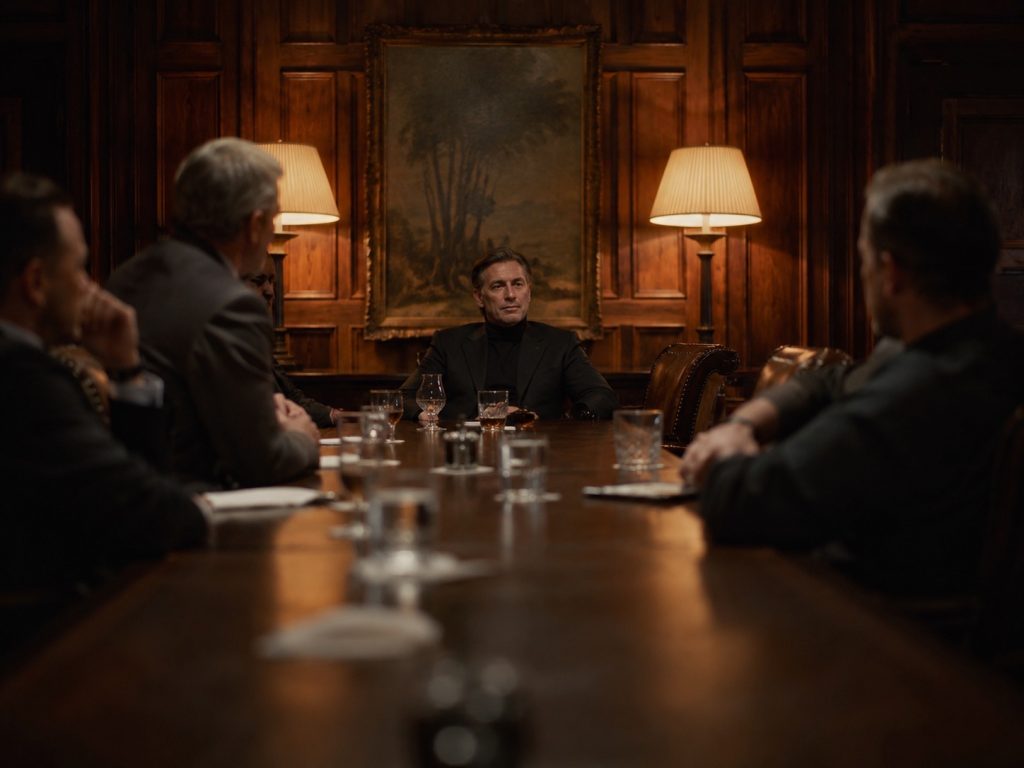
There is a particular moment, if you know to look for it, that reveals everything about a room.
It tends to arrive toward the end of a long meeting, or just after the third glass at a dinner table, when the conversation has grown comfortable enough that people begin to drop their careful performances. One man has been speaking most of the evening. He is animated, forceful in his opinions, quick with an anecdote. He commands the table the way a conductor commands an orchestra, and for a while the attention is genuinely his. There is nothing wrong with him. He is articulate. Perhaps even right.
But when the final question is posed — the one that actually matters, the one that requires a decision rather than an opinion — the room does not turn to him.
It turns to the man who has said almost nothing.
He has been sitting comfortably in his chair, observing more than participating, his expression pleasant but unreadable. When he finally speaks, he does so without preamble and without apology. His words are measured. His reasoning is clear. And the room, without quite understanding why, settles.
I have seen this dynamic in boardrooms in London and around tables in the US. The geography changes. The language changes. The dynamic does not. Authority, when it is genuine, rarely announces itself. It is recognised.
Loudness as a Substitute for Credibility
That is the observation. And it is worth sitting with for a moment before reaching for an explanation.

We live in an era that has confused loudness with leadership. Modern culture, driven by the logic of platforms and algorithms, has made visibility a form of currency. The man who speaks first, speaks often, and speaks confidently — whatever the substance of what he says — tends to be mistaken for the man in charge. And in some transient, superficial sense, he often is. He dominates the room. He controls the energy. He makes others feel that something is happening.
But there is a meaningful difference between dominating a room and shaping an outcome. The loudest voice tends to do the former. The composed man, the one with patience and precision, tends to do the latter.
This distinction is not new. It is not a modern management insight or a concept from the pages of a recent business book. It is, if anything, one of the oldest observations in the long tradition of character-based leadership — one that aristocratic culture, military tradition, and diplomatic practice have understood for centuries, even if we occasionally need reminding.
What History Quietly Teaches Us
The historical record is generous with examples, if one is willing to look at what leaders actually did rather than what mythology later attributed to them.
George Washington is the most compelling case the Western tradition offers. A man of considerable physical presence and few words, Washington was described by contemporaries as reserved to the point of formality. During the Constitutional Convention of 1787, he presided over weeks of heated debate with a composure that many attendees found both unusual and quietly commanding. He spoke seldom. He intervened rarely. His authority in that room came not from argument but from bearing — from the accumulated credibility of a man who had already, once, walked away from power.
That act of walking away is worth dwelling on. At the conclusion of the Revolutionary War, Washington resigned his military commission and returned to his farm at Mount Vernon. The gesture shocked European observers who had come to expect victorious generals to claim whatever power the moment offered. King George III reportedly said that if Washington truly stepped down, he would be the greatest man in the world. He did step down. He later departed the presidency after two terms, when continuation would have been his for the asking. The man who could have made himself king twice over chose instead to model restraint. And in doing so, he established the most durable form of authority a leader can possess: moral credibility.
Dwight Eisenhower understood a different dimension of quiet command. His philosophy of leadership was stripped of theatre. He once described the art as getting others to do something because they believe it is worthwhile, not because they were ordered to. During the Second World War, he built the Allied command less through charisma than through what might be called strategic humility: listening to difficult men, absorbing their disagreements, and synthesising from the noise a course of action that everyone could commit to. The night before the Normandy landings, he wrote a letter accepting full personal responsibility should the invasion fail. He carried it in his pocket. The letter was never needed, but the act of writing it tells you everything about how he understood his role. Leadership, in his mind, was not performance. It was accountability.
Queen Elizabeth II exercised perhaps the most patient form of authority in modern history. Across a seventy-year reign, she governed through what might fairly be described as the discipline of restraint. She spoke rarely on political matters. She offered her views in private, through channels of quiet counsel, rather than public rhetoric. During national moments of grief or uncertainty, her presence was the message. What gave those moments their weight was not the content of her words alone, but the accumulated trust she had built through decades of consistent, unshowy service. Authority, for her, was something deposited steadily over time, not spent in a single dramatic gesture.
These three figures held vastly different roles across vastly different centuries. What connects them is simple: none of them led by volume. All of them led by character, patience, and the quiet confidence of people who had no need to prove themselves repeatedly.
Presence Versus Performance
There is a distinction worth drawing here — between presence and performance — because they are frequently confused, and the confusion is costly.
Performance tries to command attention. It works through assertion, energy, and sheer momentum. It is not without value. In certain contexts — motivating a team, rallying a constituency, setting a tone — performance has its place. But performance is inherently temporary. It requires constant renewal. The man performing leadership must keep performing, because the moment he stops, the attention moves on.
Presence requires nothing of the sort. A man with genuine presence does not need to speak constantly, because his competence and steadiness are already understood. His reputation precedes him. His demeanour communicates before he has said a word. Others seek his judgment not because he has insisted they do so, but because they have learned, over time, that his judgment tends to be sound.
Environments defined by real consequence tend to reveal the difference quickly. In military command, sustained deference goes not to the man who gives the most orders but to the officer whose composure holds when the plan dissolves. In diplomatic settings, the negotiator who speaks least often hears the most. In the kind of established business culture — the sort built over generations rather than assembled from venture funding — the figures who carry weight are rarely the ones filling the room with their opinions. They ask the question that no one else thought to ask, offer the observation that reframes the conversation, and then return to listening.
The sporting world offers its own version of this. In polo, a game I have enjoyed from the low grounds of Cowdray, the National grounds of Wellington, Florida, and to the bayou city of Houston, the most effective players are rarely the most demonstrative. The sport requires something closer to economy: precise communication between horse and rider, between teammates, between instinct and judgment. The loudest player on the field is generally the most anxious one.
Why Modern Culture Rewards the Wrong Traits
It would be fair to ask why, if silent authority is so clearly effective, modern culture so reliably rewards its opposite.
The answer has something to do with the mediums through which we now observe leadership. Television, and later social media, created environments that favour what registers rather than what is sound. A composed man is difficult to broadcast. A theatrical one is not. The platforms that shape contemporary opinion are optimised for reaction, not reflection. They reward speed, certainty, and volume — which is to say, they reward the traits least associated with considered judgment.
The result is a kind of optical illusion: loudness has come to look like confidence, and confidence has come to look like competence. The man who speaks forcefully in complete sentences, without visible hesitation, is read as authoritative even when his authority rests on nothing more substantial than the force of his delivery.
But the illusion holds only at a distance. In close quarters — in rooms where decisions have consequences, where relationships extend over years rather than news cycles — the composed man tends to emerge. People who have operated at serious levels for long enough develop a kind of calibration for the difference. They have encountered enough loud people who turned out to be unreliable, and enough quiet people whose judgment proved sound, that they have learned to read the room more carefully.
Patience, in these environments, functions as a signal. The man who waits — who does not rush to fill silence, who does not feel the need to establish his credentials in the first five minutes — communicates something important about his relationship to his own security. He is not trying to convince you. He already knows who he is.
The Discipline of Speaking Last
There is a practice, observed in various forms across military, diplomatic, and executive cultures, that might be called the discipline of speaking last.
The principle is straightforward. In any meeting or discussion of consequence, the composed leader allows others to speak first. He listens. He does not interrupt. He does not offer his opinion early, because doing so would foreclose the conversation prematurely. Instead, he gathers.
This discipline accomplishes several things at once. It gives him more information than he would have if he had spoken first. It reveals how others think, what they know, and where the genuine uncertainties lie. It also invites those others to commit themselves, which means that when the leader eventually speaks, he is responding to something real rather than projecting into a vacuum. And critically, it means that when he does offer his view, the room has been waiting for it. His words carry gravity precisely because they have been withheld.
This is the strategic value of silence. When a man speaks constantly, his words become ambient — heard but not particularly absorbed. When a man speaks rarely, each statement carries weight. The room registers that something important is being said, because this is a man who does not say things carelessly.
Diplomats have understood this for centuries. The most effective negotiators are not those who articulate their position most forcefully at the outset, but those who ask the better questions and say the least until the moment requires them to say something decisive. Military commanders who have survived the longest periods of sustained operational command often describe the same instinct. You learn, at some point, that talking is rarely the highest-value activity in a room. Listening almost always is.
A Heritage of Quiet Command
The tradition in which I was raised, shaped by two cultures that share a long inheritance of land, discretion, and generational thinking, has always understood leadership this way.
In the ranching culture of the Texas Panhandle, the respected cattleman is rarely the loudest voice in the feed store or at the county meeting. His credibility comes from his land, his word, his willingness to do difficult things without announcement. He does not campaign for your esteem. He earns it through conduct over time.
The English countryside carries a parallel sensibility, perhaps more formally encoded. The tradition of the gentleman — a word that has suffered considerable abuse in recent decades — was always less about privilege than about self-command. To be a gentleman, in the classical sense, was to possess the discipline to act with restraint, to speak with care, and to lead, when asked, without making the role about oneself. Boisterousness was not a virtue. It was a symptom.
These two traditions, Texas and English, meet in my own formation, and what they share strikes me as more important than what separates them: the understanding that character is demonstrated through conduct, that authority is earned rather than claimed, and that the man who masters himself first is the one best positioned to guide others when it matters.
The Foundation Beneath It All
Leadership begins with self-possession. That is the deeper lesson beneath all of this — the one that the historical examples, the boardroom observations, and the cultural traditions are each pointing toward in their different ways.
A man who cannot govern his own need for recognition cannot govern anything more complex. A man who must fill every silence with his opinion has not yet learned that silence is often more powerful. A man who leads through volume rather than judgment has confused the appearance of authority with the thing itself.
The composed man, the one who listens before speaking, who acts deliberately rather than reactively, who earns trust through consistency rather than performance, understands something that the loudest voice in the room does not: that real influence is not taken. It is given. By others. Over time. Because they have come to believe, based on evidence accumulated slowly and without fanfare, that his judgment can be trusted when it counts.
The loudest voice may dominate a conversation. It may even dominate a room, for an evening, in a particular season.
But the composed man shapes the outcome.
Authority is rarely announced. It is recognised.

The Unofficial Ambassador for the State of Texas