Stewardship, Legacy, and the Work of Cleaning What We’ve Left Behind
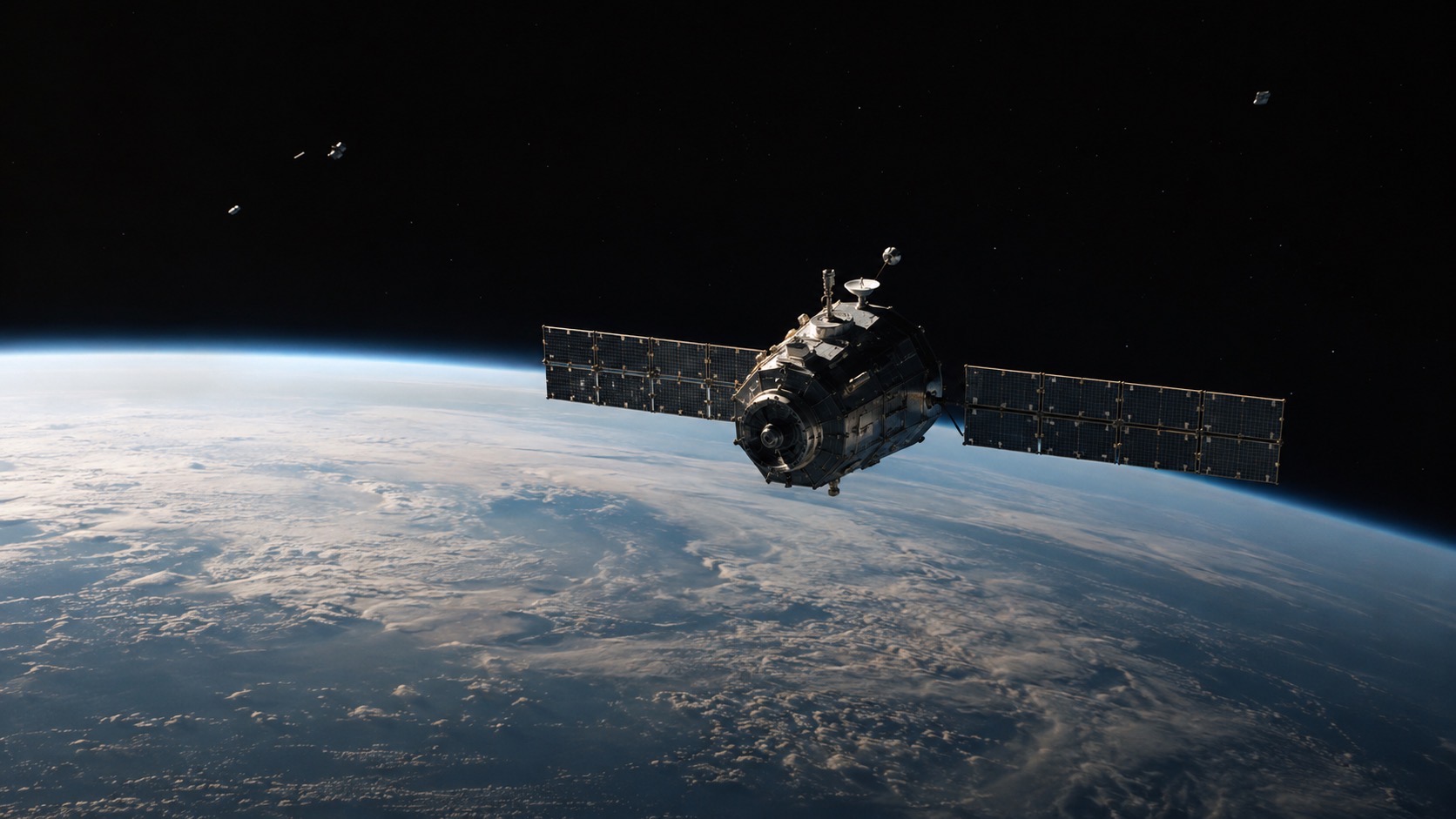
Low Earth orbit is, at present, something of an estate in disrepair. Decades of launches, experiments, collisions, and quiet neglect have left the first several hundred miles of orbital space threaded with fragments: spent rocket stages, defunct satellites, shards of metal and glass moving at velocities that render size irrelevant. Estimates place the debris population at roughly 130 million pieces, most too small to track and none of them harmless. A fleck of paint traveling at 17,000 miles per hour carries the energy of a rifle round.
Carl Sagan once reminded us that the Earth is the only home we have ever known. The orbit surrounding it belongs to that same inheritance. For years, the response has been largely institutional: studies, guidelines, declarations, and mitigation plans. Necessary work, but not enough. Concern is not the same thing as repair. That era is ending.
In 2027, two companies plan to begin turning debris removal into a repeatable commercial service, not merely a demonstration.
Portal Space Systems, based in the United States, and Paladin Space, an Australian innovator, have joined forces to bring that vision to operational reality. Their platform, Debris Removal as a Service, pairs two distinct capabilities into a single, sustained program. Portal brings the Starburst spacecraft, a maneuverable, refuelable vehicle built for extended orbital life. Paladin brings Triton, a purpose-built payload capable of identifying, categorizing, and seizing tumbling debris objects.
The partnership focuses on objects smaller than one meter, the category that accounts for the greatest collision risk and the one conventional monitoring struggles to track reliably. These are not the cinematic ruins of dead satellites drifting in silence. They are smaller, harder to see, and more difficult to predict, which is precisely why they matter. A single Starburst mission, equipped with Triton, is designed to clear multiple targets before returning for service. Scale changes the economics of what’s possible. Repeated operations change what debris removal can become.
“Most collision-avoidance activity is driven by small debris,” said Harrison Box, Chief Executive of Paladin Space. “Triton is built to remove dozens of those objects in a single mission, which fundamentally changes the cost structure of debris remediation.”
Jeff Thornburg, Chief Executive of Portal Space Systems, has been equally direct. “This is about making debris removal operational, not experimental. Satellite data underpins communications, navigation, weather forecasting, and national security. Maintaining that infrastructure requires active debris management.”
Both men understand that the orbital environment isn’t a byproduct to be managed at the margins. It is infrastructure. And when infrastructure is left to degrade, everything built on top of it eventually follows.
Portal’s Starburst-1 is scheduled for launch in late 2026 aboard a SpaceX rideshare mission, with full commercial operations planned for 2027. In April, Portal secured fifty million dollars in Series A funding to accelerate development. Starlab Space, which is preparing to operate a commercial space station, has already signed a letter of intent to incorporate cleanup services into future operations.
That detail is telling. A future space station is planning for orbital maintenance from day one, treating it as a feature of sustainable operations. That’s the thinking of a long-term tenant, not a short-term visitor.
Moriba Jah, an astrodynamicist and space sustainability advocate, has long argued for treating orbital space as a dynamic ecosystem, one in which changes in any part ripple across the whole. His framing draws from traditional ecological knowledge, the principle that accountability can’t be deferred and that the consequences of neglect belong to those who come after. The circular space economy he envisions follows the same logic as a well-managed ranch. Take what is needed, return what was borrowed, and leave the range better than you found it.

Stewardship has never been a glamorous word. It doesn’t arrive with fanfare. It shows up before the rest of the world is paying attention, in the form of a decision to maintain rather than abandon, to repair rather than replace, to think past the current season.
The work Portal and Paladin are undertaking will produce no visible change on a clear night. Two spacecraft will move quietly through low Earth orbit, doing what should have begun years ago. Slowly, methodically, the debris population will thin.
The sky will look identical.
But it will be a different sky, tended at last with the seriousness the commons has always deserved.

The Unofficial Ambassador for the State of Texas