There is a sense of poetry to the scent of real leather when you open the door to a finely appointed vehicle. It evokes not only refinement, but permanence. You don’t simply sit on leather; you settle into it. It absorbs the years, the journeys, the lives lived along winding roads and polished boulevards. And yet, as the modern world rushes toward synthetic everything—leatherette, vegan leather, PU, PVC—the question arises, “Is real leather still worth choosing?”
The answer, as you may suspect, is yes. Not out of sentimentality, but out of truth. A truth grounded in environmental stewardship, craftsmanship, and the elegant honesty of natural materials.
A Material With Memory
Leather, at its core, is a byproduct of something deeply interwoven with human history: animal husbandry. For millennia, it has offered durability, comfort, and luxury across cultures—from Roman legionnaires’ saddles to the gentleman’s Chesterfield. And while its rivals in synthetic forms attempt to mimic its softness or durability, none have succeeded in replicating its essence. Leather is not merely a covering; it’s a material with memory.
Yet in today’s eco-conscious age, it’s fair to ask—does that legacy come at a cost?
The Environmental Equation: Real vs. Synthetic
Contrary to popular marketing claims, real leather—particularly as it is used in the automotive world—is not an environmental villain. In fact, when understood fully, it often proves to be the more sustainable choice compared to so-called vegan leathers.
Real leather is a byproduct, not a primary product. The hides used in automotive interiors are sourced from animals already being raised for meat and dairy production. Without a use for those hides, they would end up as landfill waste. According to the Leather and Hide Council of America, 33 million hides are discarded globally each year—a tragic loss of a natural resource that could otherwise serve a purpose for decades.
In contrast, synthetic leathers—whether polyurethane (PU) or polyvinyl chloride (PVC)—are plastics derived from fossil fuels. Their production emits volatile organic compounds (VOCs), and they do not biodegrade. What’s more, many of these “vegan” alternatives contain harmful chemical softeners and microplastics that eventually enter the ocean and food chain.
A 2021 study by FILK Freiberg Institute in Germany comparing leather and alternatives found that genuine leather outperformed synthetic leathers in terms of longevity, abrasion resistance, and environmental impact over time.
What Kind of Leather?
In the realm of luxury automobiles, not all leather is created equal. If you’re investing in an interior, it’s worth knowing the terms and understanding what you’re sitting on.
1. Full-Grain Leather
This is the highest quality leather, taken from the top layer of the hide. It includes the natural grain, with all the strength, texture, and unique character that comes from the animal’s life. It ages beautifully, developing a rich patina over time.
Brands like Bentley and Rolls-Royce often use full-grain leather, tanned and dyed by artisans in places like Bridge of Weir (Scotland) or Poltrona Frau (Italy). Expect subtle color variation and remarkable softness.
2. Top-Grain Leather
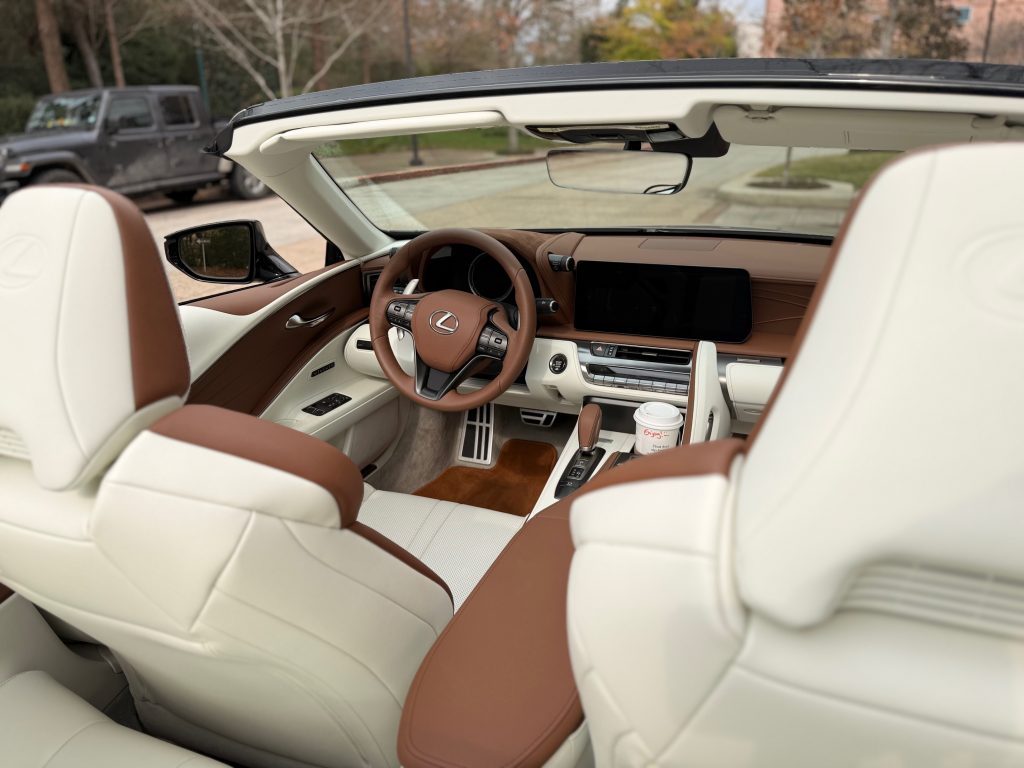
Slightly more processed than full-grain, top-grain leather has the outermost surface sanded down for a more uniform appearance. It’s still luxurious and durable, but lacks the patina potential of full-grain. Lexus, Mercedes-Benz, and BMW often utilize top-grain for balance between aesthetics and durability.
3. Corrected Grain (Embossed Leather)
Here, imperfections are buffed out and a grain is mechanically embossed onto the surface. It’s more affordable, highly uniform, and easier to clean—making it common in more accessible luxury trims like the Infiniti QX60 or Acura MDX.
4. Bonded Leather
This is essentially leather dust bound together with adhesives and polymers—more akin to particle board than oak. It looks like leather from afar, but offers none of the longevity, breathability, or natural feel. Avoid it entirely in any vehicle claiming to be premium.
Understanding the Terminology
To truly navigate leather interiors like a seasoned connoisseur, it’s worth decoding some of the terms automakers use:
● Semi-Aniline Leather: Lightly pigmented and dyed, retaining much of the hide’s natural softness while offering some protection. Common in high-end trims.
● Nappa Leather: Marketing term often used for soft, chrome-tanned, full-grain or top-grain leather. Not all Nappa is created equal—some is divine, some is merely rebranded corrected grain.
● Vegetable-Tanned: Uses organic materials like bark and leaves in the tanning process. Time-intensive, eco-friendly, and aromatic, but less common in cars due to susceptibility to water stains.
● Chrome-Tanned: Uses chromium salts for quick, uniform tanning. More water-resistant, softer, and common in automotive leather.
What Buyers Should Look For
If you’re shopping for a vehicle and leather matters, don’t just check the spec sheet—check the seat itself.
1. Touch: Genuine leather has depth and variation. It warms to the touch, whereas synthetics remain cool and slightly tacky.
2. Smell: That classic leather scent is unmistakable. Plastics may try to imitate it, but the synthetic aroma gives them away.
3. Grain: Look closely—real leather will often show pores, scars, and wrinkles. Uniformity can be a red flag.
4. Breathability: Leather allows air flow and temperature adaptation. Ever sat on a vinyl seat in August? Case closed.
Ask your dealer or brand concierge where the leather is sourced. True luxury brands are often proud of their leather heritage—naming Scottish tanneries or Italian houses as a point of distinction.
Luxury automakers take extraordinary measures to ensure the quality of their leather interiors. Rolls-Royce sources hides from 15 to 18 bulls per vehicle, selecting animals raised in colder climates to reduce imperfections from insect bites. Bentley and McLaren likewise favor bull hides for their thickness, durability, and consistency—an approach McLaren’s senior designer confirms is central to their trim philosophy.
Maintenance: Stewardship Over Time
Leather rewards care. It softens, it ages, it develops character. Much like a favorite pair of boots or an heirloom briefcase, leather interiors become more beautiful over time—if maintained. That’s part of the appeal for those who think generationally.
Use a natural cleaner and conditioner twice a year. Avoid silicone sprays or harsh detergents. If a car is stored outdoors or in intense sunlight, consider UV protectants to keep the leather from drying out.
Where synthetics crack and peel, real leather can be reconditioned and re-dyed. It’s a material that forgives, and endures.
The Old Money Argument
Let us not overlook the cultural and aesthetic elements. In the circles where real elegance whispers rather than shouts, leather interiors remain a hallmark of old-world taste. They are found in the estates of English country gentlemen, in the bespoke Range Rovers of Nairobi expats, in the cherished Wagoneers of Texas ranchers.
This is not about status for status’s sake. It’s about fidelity to materials that speak of real lives, real time, and real stories. One doesn’t brag about leather. One lives with it.
The Case for Real Things in a Synthetic World
We live in a time increasingly defined by the simulated: LED fireplaces, fake plants, artificial sweeteners, synthetic fabrics. In that context, real leather, properly sourced, ethically tanned, and beautifully crafted—is a rebellion of authenticity.
It’s no longer a question of new vs. old. It’s a matter of integrity. For those who see their vehicles not as mere transport but as expressions of self—of character, tradition, and heritage—real leather interiors remain the definitive choice.
Citations (With Links):
1. Washington Post — “Vegan leather isn’t as sustainable as you think.” An investigation into the environmental footprint of synthetic alternatives.
2. COSH! Eco Platform — “Natural leather: the history, environmental impact and sustainability.” This article explores full-grain leather’s enduring place in a circular economy.
3. Pangea Made – 2023 Sustainability Report — A material supplier’s audit of lifecycle, water use, and carbon efficiency.
4. Leather Naturally — Features and industry briefings on ethical sourcing, lifecycle responsibility, and biodegradability of hides.
5. FILK Freiberg Institute — “Comparative Life Cycle Assessment of Leather and Leather Alternatives.” A respected scientific study published by the German polymer and leather research center.
6. Leather & Hide Council of America — Press releases and environmental commitments from U.S. tanners and hide exporters.
7. International Council of Tanners — “COP28 Leather Manifesto,” articulating leather’s role in the regenerative material conversation.
8. World Wildlife Fund (WWF) — “Sustainable leather sourcing: from ambition to action.” A call for responsible upstream hide processing.
9. Wikipedia — Entry on Artificial Leather. An accessible summary of the manufacturing process and common petroleum-based synthetics.
10. Car and Driver – Why car makers only use steer hides.

The Unofficial Ambassador for the State of Texas