There’s a particular kind of evening in Texas, when the light goes amber and the temperature drops just enough to make you grateful for the heated seats. You’re twenty miles from anywhere that matters, the road is empty, and the V12 ahead of you is making a sound that belongs in a concert hall. This is when you understand what Aston Martin has been building toward for the past two decades. Not just cars. Something larger.
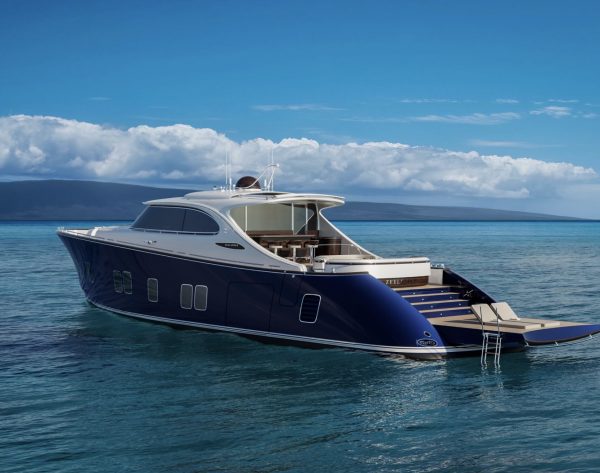
The transition hasn’t been loud. Aston Martin doesn’t operate that way. But somewhere between the DB7 Vantage of 2000 and this 2026 Vanquish Volante, the company stopped being merely an automotive manufacturer and became something closer to a custodian of a particular approach to life. The Art of Living, I call it. The phrase could sound pretentious in the wrong hands, but when you’re standing in front of their apartments in Miami, or the AM37 speedboat cutting through Caribbean water, you realize the philosophy runs deeper than marketing.
This matters because the Vanquish, both coupe and Volante, represents the heart of that vision. Not the Valkyrie with its pure racing DNA. Not the Valhalla with its hybrid complexity. The Vanquish. A car built for the person who appreciates craftsmanship across industries, who understands that a weekend at the Courmayeur Ice Driving Experience is as much about ritual as skill, who drinks mezcal rarely but always with intention. The target here isn’t someone who needs convincing about luxury. It’s someone who already knows the difference between expensive and valuable, and who won’t settle for anything less than both.
Robb Report understood this. When they recently named the Vanquish their Car of the Year, they weren’t just recognizing horsepower or aerodynamics. They were acknowledging something more fundamental: that in an age of electric silence and algorithmic precision, there’s still profound appeal in a twin-turbocharged V12. In a machine that makes you feel something before you even turn the key.
The Volante version (the Italian word for flying they’ve given all convertibles since 1965) I’m driving belongs to that lineage. It’s the drop-top variant of Aston Martin’s flagship, arriving in the second half of 2025 with credentials that would make a Ferrari 12Cilindri owner take notice. Eight hundred twenty-four horsepower. Seven hundred thirty-eight pound-feet of torque. One thousand Newton-metres if you prefer it the English way. The fastest, most powerful front-engine convertible in production. Numbers like these used to be enough. Now they’re merely the starting point.
Walking the Exterior: Proportion as Philosophy
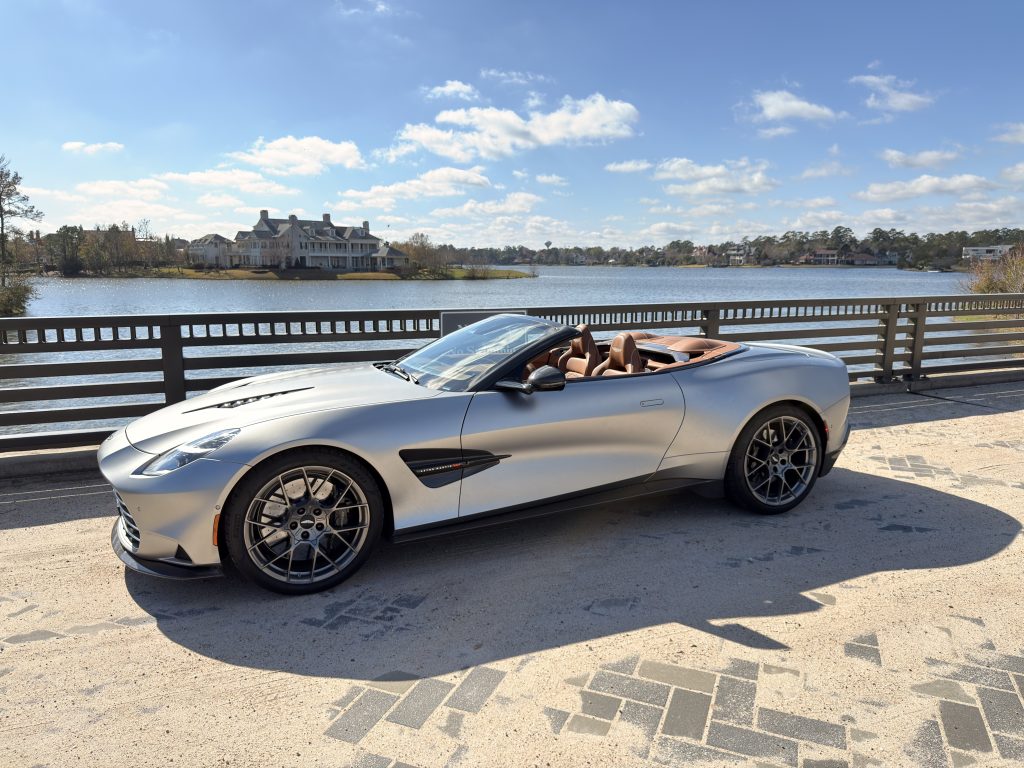
You approach the Vanquish Volante from an angle. Never head-on. This is a car that reveals itself in layers, and the silhouette from thirty feet away tells you everything about proportion before you notice a single detail. The designers have stretched the wheelbase eighty millimeters beyond the previous DBS Superleggera, added twenty-five millimeters to the rear track, and somehow made the whole thing look both more muscular and more refined. That’s not an easy balance.
Marek Reichman, the Chief Creative Officer, calls it a shark nose. The grille is thirteen percent larger than before, feeding air to that tremendous V12, and the aggressive stance comes from pushing the front wheels so far forward that the hood seems to go on for days. This is intentional. The entire engine sits behind the front axle, creating a near-perfect weight distribution and that distinctive Aston Martin posture. Authority without aggression. Confidence without shouting.
The carbon fiber adorned hood is dramatic in its simplicity and punctuated by sculpting that serves both aesthetics and airflow. Move around to the sides and the fender vents announce themselves. These aren’t decorative. They’re functional, pulling heat away from the engine bay and contributing to the car’s remarkable stability at speed. The designers understood something crucial: the best details serve multiple purposes, and ornament without function is just jewelry.
But it’s the rear treatment that stopped me cold. The taillights are unlike anything else on the road, widening the visual stance of the car and creating a signature that you’d recognize a mile back on a dark highway. Below them sits what Aston calls a shield, flanked by four exhaust tips that are genuinely massive. I’m testing the optional titanium system, which is lighter and slightly higher-pitched than the standard stainless steel. The sound difference is subtle until you accelerate hard, then it’s everything.
The convertible top deserves its own paragraph. Or more. It uses what Aston calls a K-fold mechanism, an engineering solution that allows the fabric to stack tightly into the rear deck without compromising the car’s lines. With the top raised, eight layers of material (including Alcantara on the inside) create a cabin that’s genuinely quiet. Save for a grumble of that glorious V12. Hit the silver switch by the cup holder, wait fourteen seconds, and the roof disappears into a compartment so cleanly integrated you’d never know it was there. This is craftsmanship. Not the mechanism itself, necessarily, but the obsessive attention to making it invisible when you don’t need it.
The Interior: Where Ritual Meets Technology
Opening the door requires a firm pull. The weight of it, the precision of the hinge, the soft thunk when it closes. These aren’t details you think about consciously, but they set the tone for everything that follows. Sink into the driver’s seat and the first thing you notice isn’t the screens or the carbon fiber. It’s the sense of occasion. The seat holds you without gripping. The steering wheel sits at exactly the right angle. The pedals are where your feet expect them to be. This is what happens when engineers understand that a car is a tool first and a statement second.
The dashboard manages something rare: it integrates modern technology without letting it dominate. Two ten-inch displays handle the gauge cluster and infotainment, substantial enough to be useful but not so large they feel like afterthoughts from a Silicon Valley startup. The screens sit in frames of carbon fiber that give them depth and purpose. Around them, knurled metal controls for climate and driving modes feel expensive in your hand. This is the kind of tactile satisfaction that touchscreens can never replicate, and Aston Martin knows it.
Apple CarPlay Ultra runs through the center screen, and here’s where the integration gets clever. You can now control driving modes, climate settings, and core vehicle functions without leaving the Apple interface. This matters more than it sounds. Too many luxury cars force you to learn two separate systems, one for the car and one for your phone. The Vanquish treats the phone as the primary interface and makes the car adapt to it. Subtle, but profound.
Materials throughout the cabin reflect what you’d expect from a car at this level, which is to say they’re beyond reproach. The leather is substantial. The Alcantara on the headliner feels appropriate rather than trendy. The carbon fiber is real, not a printed pattern pretending to be something it’s not. But more important than any individual material is how they work together. The color palette in my test car is a study in restraint: charcoal and tobacco with minimal contrast stitching. This is what confidence looks like. No need to announce itself.
The trunk won’t hold much. That’s fine. This is a car for weekend trips, not grocery runs, and the intended buyer has already arranged for the rest of their luggage to be shipped ahead to the villa or the resort. What matters is that the space is properly lined, properly finished, and properly sealed against the elements. Details matter when you’re spending this kind of money, and Aston Martin doesn’t cut corners where you can’t see them.
Driving: Power as Presence
Start the engine and the V12 settles into a low rumble that you feel more than hear. This is the new 5.2-liter unit, twin-turbocharged, producing numbers that would have seemed impossible twenty-five years ago when Aston first introduced V12 power to the lineup. Back then, the DB7 Vantage made 420 horsepower from a 5.9-liter engine. Today, this smaller unit makes 824. Nearly double the power from less displacement. That’s not marketing. That’s engineering.
Simon Newton, Aston Martin’s Vehicle Performance Director, explains that the entire engine is packed toward the cabin, maintaining that crucial near-fifty-fifty weight distribution despite the massive hood. The Volante weighs two hundred nine pounds more than the coupe because of the convertible mechanism and additional chassis bracing, but my test car tries to offset some of that with the titanium exhaust. It’s a losing battle against physics, but an honorable attempt.
Pull onto the road in GT mode and the car behaves like a proper grand tourer. The eight-speed ZF automatic transmission shifts smoothly, almost invisibly. The adaptive suspension reads the road surface and adjusts in real time, giving you a ride that’s firm without being punishing. You could drive this thing across the continent and arrive refreshed. That’s the point. But there’s something else happening beneath the civility, a sense of barely contained energy that makes you keenly aware of what’s waiting if you just ask for it.
Ask for it. I dare you! Switch to Sport mode and the car changes personality. The throttle response sharpens. The transmission holds gears longer. The exhaust note opens up into something more urgent, more insistent. And the power. The power is absurd in the best possible way. It doesn’t arrive all at once like some turbocharged four-cylinder snapping awake at four thousand RPM. It builds. A surge that keeps climbing as your right foot goes down, a tsunami of torque that feels bottomless no matter what gear you’re in or what speed you’re carrying.
Zero to sixty happens in 3.3 or 3.4 seconds depending on conditions and how brave you’re feeling. The traction control works overtime to keep all that power headed in roughly the right direction, but this is still a rear-wheel-drive car with eight hundred twenty-four horses trying to overwhelm contact patches. The electronic differential helps. So does the seventy-five percent stiffer chassis compared to the old DBS Volante. But physics is physics, and if you’re not careful with the throttle, you’ll find yourself facing backward wondering what happened.
In GT mode, the car’s computer deliberately limits power in the first four gears. This isn’t coddling. It’s intelligence. Give a driver full access to eight hundred twenty-four horsepower in first gear and you’re essentially asking them to break something, probably traction and possibly more. Sport mode removes the limiters, trusting you to manage the relationship between your right foot and the laws of physics. It’s a dance. Learn the steps or pay the price.
The steering is electric, which purists will note with some skepticism. They’re not entirely wrong. You lose a bit of the fine-grain feedback that a hydraulic system provides. But the upside is precision. The car responds exactly where you point it, with almost no play at center. For a grand tourer, that’s the right trade. You want accuracy more than you want conversation from the front wheels. You want to place the car exactly where you intend it to be, mile after mile, without constant correction.
Through corners, the Vanquish Volante tends toward understeer in the initial turn-in. This is by design. A car with this much power needs to be stable, especially with the top down and the center of gravity slightly higher than the coupe. But apply throttle mid-corner and the rear differential starts working, rotating the car and pointing you toward the exit. Too much throttle and you’ll overwhelm the traction control, spinning the rear end around in a way that’s either thrilling or terrifying depending on your skill level. The limit is high but not infinite. Know where it is.
Top speed is 214 miles per hour, whether the roof is up or down. That’s not theoretical. According to Newton, they tested it both ways. You won’t reach that speed on public roads, obviously, but knowing it’s available changes how you think about the car. This isn’t a machine constrained by artificial limits. It’s built to operate at speeds most cars can’t even approach, and it does so with the same composure it shows in suburban traffic. That’s the real achievement.
What surprises me most is how the experience changes with the top down. It’s not just about wind in your hair or sun on your face, though those elements matter. It’s about the way the V12’s note fills the cabin, no longer filtered through Alcantara and acoustic glass but direct and immediate. It’s about seeing the landscape above you as well as beside you, connecting to the environment in a way that’s impossible in a coupe. The convertible sacrifices a tiny bit of structural rigidity, yes. But what it gains in experience more than compensates.
Summary
It’s hard to imagine a grander touring car. That’s not hyperbole. This is what happens when a company that’s been building high-performance GTs for decades decides to make the definitive statement. The Vanquish Volante delivers eight hundred twenty-four horsepower with the civility of a luxury sedan and the drama of a supercar. It crosses continents as easily as it attacks back roads. It looks equally appropriate at a country estate or a five-star resort. And it does all of this while maintaining the particular character that makes an Aston Martin different from anything wearing a Prancing Horse or a Raging Bull.
The client who’ll buy this car already knows what they want. They’re forty to sixty years old, successful in their own right, probably an entrepreneur or a professional who’s built something meaningful. They’ve owned other exotic cars and understand that badges don’t equal substance. They appreciate craftsmanship whether it appears in a watch, a building, or a V12 engine. They travel frequently, read selectively, and make decisions based on value rather than price. These are the people Aston Martin has spent decades building a lifestyle around, and the Vanquish Volante is the flagship expression of that vision.
There’s nothing I would change. That statement comes after a couple hundred miles in various conditions, with the top up and down, in traffic and on empty highways, pushing hard and cruising easily. The car strikes the balance between performance and luxury so precisely that adjusting either element would throw off the whole equation. Want more track capability? Buy a Valhalla. Want more luxury? Commission a Rolls-Royce. The Vanquish Volante occupies the exact point where those two worlds intersect, and it does so with confidence.
Twenty-five years ago, Aston Martin introduced V12 power to their lineup with the DB7 Vantage. The transformation from 420 horsepower to 824 tells only part of the story. The real evolution is how the company has grown from making exceptional cars to creating an entire approach to living well. The Vanquish Volante embodies that philosophy. It’s not just transportation. It’s ritual, identity, and a particular way of moving through the world.
On that Hill Country evening, with the light going amber and the V12 singing its complicated song, you understand what Aston Martin has built. Not the fastest car. Not the most powerful. The most complete. The flagship. The one that defines everything else. As far as making the ultimate quintessential Aston Martin, they’ve succeeded completely. The Vanquish Volante is exactly what it should be, and that’s everything.

The Unofficial Ambassador for the State of Texas